

For most of my life, I thought I was normal.
Not normal in the sense that everything was easy. I knew I was driven. I knew I was intense. I knew my brain never stopped moving. But I assumed everyone lived with the same internal soundtrack. Everyone must have been constantly assessing risks, anticipating problems, preparing for disasters, and calculating contingency plans.
That was just adulthood.
That was responsibility.
That was success.
At least, that’s what I told myself.
The truth is that somewhere around the age of fifteen, my nervous system made a decision.
The world was not safe.
It wasn’t a conscious decision. It wasn’t something I voted on. It was a survival adaptation forged in a moment when life stopped making sense. One day I was a teenager worried about grades, friends, comic books, and what the future might hold. The next, I was standing in a hospital watching my mother die.
My brain learned a lesson that day.
Anything can happen.
Anyone can disappear.
You must be ready.
And so I was.
For decades.
I built a life that many people would admire. I became a lawyer. Built a successful practice. Tried cases. Led organizations. Taught seminars. Raised children. Supported clients through some of the worst moments of their lives.
From the outside, I appeared confident.
From the inside, I was always on watch.
My mind was a security guard working a double shift that never ended.
Every room was scanned.
Every conversation analyzed.
Every future catastrophe anticipated before it happened.
I wasn’t relaxing.
I was preparing.
I wasn’t resting.
I was monitoring.
I wasn’t present.
I was surviving.
The strange thing about living in a constant state of vigilance is that eventually you stop noticing it. A fish does not notice water. It simply swims.
I had no idea that most people did not live this way.
I thought the constant noise in my head was normal.
I thought always being ready was a virtue.
I thought the ability to anticipate every possible problem was a gift.
And in many ways, it was.
It helped me build a career.
It helped me protect clients.
It helped me navigate adversity.
But it came with a cost.
Feelings became muted.
Rest became difficult.
Being present became almost impossible.
I was always somewhere else—replaying the past or preparing for the future.
Rarely just here.
Then, fourteen months ago, I started EMDR therapy.
If I’m being honest, I didn’t know what I was getting into.
There were paddles.
There were lights.
There were memories.
There were questions.
And there was Heather, patiently guiding me into places I had spent a lifetime avoiding.
At first, the changes were subtle.
I remember getting goosebumps.
That sounds insignificant, but it wasn’t.
Something inside me was waking up.
Then came emotions.
Not dramatic emotions.
Normal emotions.
The kind most people experience without thinking.
I realized I had spent years observing feelings more than actually feeling them.
Before EMDR, I could count on one hand the number of times I had cried as an adult.
Now tears arrive when they belong.
At funerals.
During meaningful conversations.
Listening to a song.
Reading something beautiful.
Watching someone I love succeed.
The emotions are no longer trapped behind glass.
They’re part of the experience.
The biggest surprise, however, was silence.
Not actual silence.
Internal silence.
For as long as I can remember, my brain was a hamster on a wheel. Constant movement. Constant analysis. Constant preparation.
One day I noticed something unusual.
The wheel had stopped.
Not permanently.
Not completely.
But I discovered that I could actually quiet my mind.
I could sit with a moment instead of dissecting it.
I could experience something without simultaneously preparing for what came next.
For someone who spent forty years living in survival mode, this felt almost supernatural.
Another unexpected casualty of healing was my combative nature.
I had always viewed it as part of my personality.
I was direct.
Argumentative.
Ready.
Prepared for battle.
A useful trait for a trial lawyer.
But as the work progressed, I began to realize that much of that energy wasn’t confidence.
It was defense.
A shield that had become so familiar I mistook it for my identity.
As that shield softened, something else emerged.
Curiosity.
Patience.
Presence.
The need to fight every battle slowly disappeared.
Not because I became weak.
Because I no longer felt under attack.
Then came a session I will never forget.
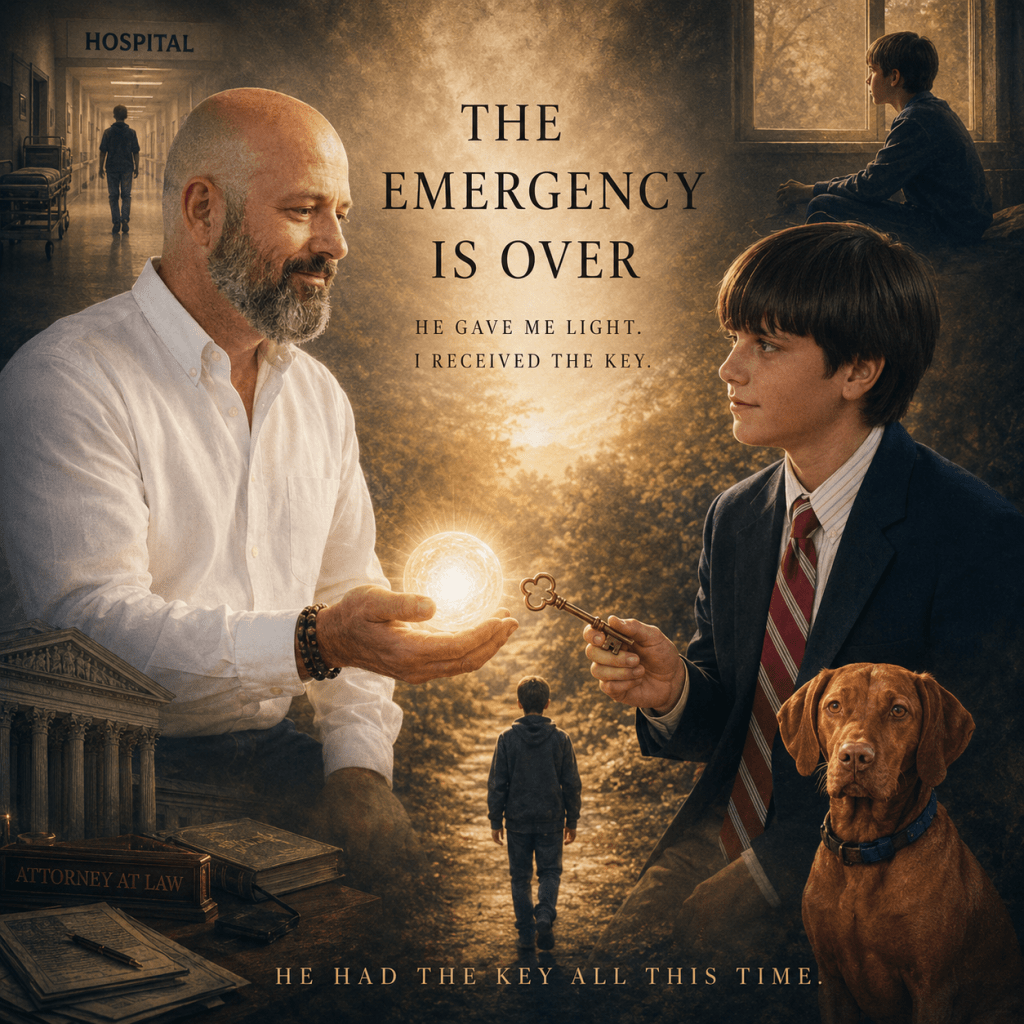
I found myself standing face to face with my fifteen-year-old self.
Not as a memory.
Not as a photograph.
As a person.
The boy whose world had ended.
The boy who had lost his mother.
The boy who had been forced to grow up far too quickly.
I was carrying a glowing orb of light.
I don’t know where it came from or what it represented.
Healing.
Safety.
Compassion.
Understanding.
Maybe all of those things.
I handed it to him.
He took it without hesitation.
Without suspicion.
Without fear.
He slipped it into his pocket as though it belonged there.
Then he looked at me and smiled.
“What took you so long?”
Not with anger.
Not with resentment.
With relief.
As though he had known I would eventually find my way back.
As though he had been waiting for me all along.
Then he reached into his pocket and handed me a key.
A simple key.
And in that moment everything changed.
The light was something I thought he needed.
The key was something I didn’t know I was missing.
For years I had believed that fifteen-year-old boy was frozen in the hospital room.
Broken there.
Trapped there.
Waiting to be rescued.
But the image suggested something entirely different.
He wasn’t broken.
He survived.
While I was busy building a career, building a family, building armor, he had been quietly safeguarding parts of me that I could not afford to access while surviving.
Wonder.
Sadness.
Joy.
Hope.
Trust.
The ability to feel deeply.
The ability to simply be.
I thought I had come there to save him.
Instead, he was helping me.
The lawyer built a career.
The adult built a life.
The survivor built armor.
But the boy held the key.
Patiently.
Faithfully.
Waiting until I was finally ready to receive it.
That may be the greatest gift EMDR has given me.
The realization that the emergency is over.
The world still contains risk.
People still get hurt.
Tragedy still exists.
But my nervous system no longer believes every moment requires readiness for disaster.
I spent decades standing guard over a threat that had already passed.
The teenager who lost his mother did exactly what he needed to do to survive.
He became vigilant.
He became productive.
He became successful.
He became indispensable.
I am grateful for him.
He got me here.
But I no longer need him standing watch twenty-four hours a day.
Today, I am learning something new.
How to feel.
How to be present.
How to trust quiet.
How to sit in a moment without searching for the exit.
I don’t fully understand how those paddles work.
I don’t know exactly where this journey leads.
What I do know is this:
For decades, I believed healing meant finding something that had been lost.
Now I think healing may be something else entirely.
Maybe healing is returning to the place where you left a piece of yourself behind and discovering that it never left.
It was there all along.
Holding a key.
Waiting patiently for you to come back.
And after all these years, that feels like coming home.



Leave a Reply