


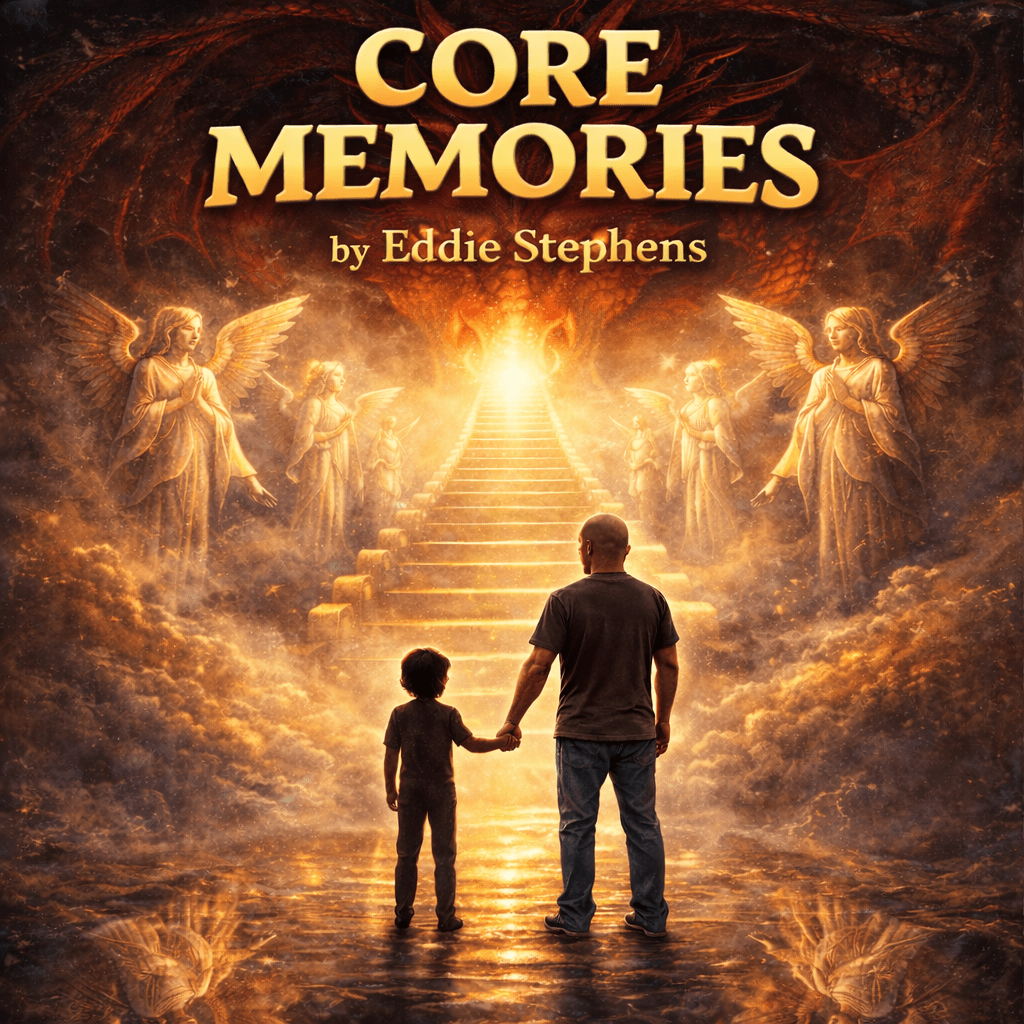
I used to think “core memories” were like museum pieces, sealed behind glass, labeled, safely preserved. The older I get, the more I realize they’re more like live wires.
They don’t sit still.
They hum.
They rearrange themselves depending on what season of life I’m standing in, what I’m afraid of, what I’m brave enough to admit, and what I’m still pretending I don’t feel. A memory I once called “funny” becomes “sad” when I finally understand what was happening offstage. A memory I labeled “trauma” becomes “origin” when I stop trying to erase it and start learning from it.
That’s the strange grace of time, it doesn’t delete anything. It just keeps handing you new angles.
When I was younger, I wanted a clean storyline. Beginning, middle, end. A satisfying arc where the pain is neatly resolved, the villain is clearly identified, and the hero gets his reward.
But life isn’t a screenplay.
Some of these chapters are bright. Those moments where I touched something bigger than myself: curiosity, music, mischief, tattoos, code, the magic trick of learning.
And some of these chapters are heavy. They live in the body more than the mind.
I’ve told these stories because I’m done pretending they didn’t shape me.
I’ve told them because I’ve spent too much of my life trying to be invincible… trying to “win” the past by outrunning it. That’s a losing strategy, by the way. The past has endurance. The past is patient.
So I stopped running.
Or at least, I started running in a different direction: toward meaning.
Somewhere along the way, a teacher handed me Joseph Campbell’s Hero’s Journey, and something inside me clicked, not because I suddenly believed I was a hero, but because I recognized the pattern.
A call.
A loss.
A threshold.
Tests.
Allies.
A descent.
A return.
Not as fantasy, more like a blueprint for surviving the parts of life that don’t come with instructions.
I didn’t understand it all then. I understand a little more now.
Here’s what I know: the “ordinary world” is not something you leave behind once. It’s something you keep losing and finding and rebuilding. Over and over again. Sometimes you return to it. Sometimes you create a new one. Sometimes you realize the world was never ordinary at all, you were just too young to see how fragile it was.
And if you’ve read this far, you know the moment my ordinary world ended.
I carry my mother’s absence the way you carry a scar: it’s proof something happened, and proof you made it through. A scar isn’t pretty, but it’s honest. It’s the body’s way of saying: there was damage here, then there was healing.
There’s a temptation, when you write about grief, to tie it up in a bow. To offer a tidy lesson. To make it inspirational.
I’m not interested in that.
The truth is: I miss her. I miss the idea of her. I miss what could have been. I miss what I needed and didn’t get, and what I got and didn’t recognize until it was gone. I miss the version of me that might have existed if the universe hadn’t made that cut.
And at the same time, this is also true, I am who I am because of what happened.
Not in a romantic way. Not in a “everything happens for a reason” way.
In the simplest, hardest way: you adapt or you break.
After she died, something in me flipped. The part of me that had drifted, disengaged, checked out…. vanished.
In its place came a fierce, almost desperate devotion to mastery.
Straight As weren’t about trophies; they were about control. They were about building a world where effort had predictable outcomes.
That’s a complicated thing to admit.
It’s also a complicated thing to live with.
Because that kind of drive can build a career and also build a cage. It can make you “the one who handles things” until you forget how to be the one who feels things.
So I’m writing this epilogue as a small act of disarmament.
A way of saying: yes, I’m strong, and yes, I’m still tender in places people don’t see but I am hardly “invincible”.
If you know me in real life — the suit-and-tie version, the courtroom version, the let’s do our best version — then you should know this too:
Underneath that is a boy who learned early that love can disappear without warning.
For a long time, I thought my job was to protect him. I thought healing meant rescuing him. I thought maturity meant leaving him behind.
I don’t believe that anymore.
What I’ve come to understand is that he was never trapped in the past. He wasn’t frozen in a hospital room. He wasn’t waiting to be saved.
He was carrying something.
Something I needed.
While I was busy becoming who I thought I had to be, he was quietly safeguarding the parts of myself that survival required me to set aside.
Wonder.
Trust.
Curiosity.
Grief.
Joy.
The ability to feel deeply. The ability to remain open despite knowing how much life can hurt.
For most of my adult life I mistook those qualities for vulnerabilities. Things to manage. Signals to suppress. I built competence around them the way you’d build a wall around something fragile — not to destroy it, but because the world didn’t seem like a safe place to leave it exposed.
The wall worked. I became someone who could handle things. Someone steady under pressure, effective in chaos, reliable when everything else was falling apart. The courtroom. The firm. The reputation. The record.
But walls don’t distinguish between what they keep out and what they keep in.
The older I get, the more I realize he wasn’t the wounded part of me.
He was the keeper of something essential.
And when I was finally ready, he handed it back.
…
These memories — every weird, hilarious, painful, magical shard — are not just a scrapbook.
They are not evidence.
They are breadcrumbs.
A trail leading back toward a self I thought I had outrun. The remarkable thing is that I never actually lost it. It was there the whole time, intact, patient, holding everything I had been too busy to carry.
That’s what this project has been, underneath all the stories. Not documentation. Not legacy-building. Not even writing, exactly.
It’s been a conversation with someone I had been avoiding for a long time.
And it turns out he had a lot to say.
…
This collection isn’t finished. It can’t be. Because as long as I’m alive, the story is still unfolding. The meaning is still developing. The wounds are still healing. The love is still finding new ways to express itself.
A life isn’t a solved equation.
It’s a living draft.
…
I don’t know what your core memories are. I don’t know what you’ve survived or what you’ve lost. But I know this:
You are not just the worst thing that happened to you. You are not just the ways you adapted. You are not just the armor you built.
Somewhere inside you is a version of yourself that remembers who you were before the world convinced you to become someone else. And if you’re fortunate, and patient, and brave enough to keep looking, you may find that the person you’ve been searching for has been searching for you too.
If these chapters did anything — if they sparked recognition, softened something, or made you feel less alone — then the telling was worth it.
…
The Preface opened with a question I didn’t know I was carrying: Who was I before I learned to be useful?
This is the answer.
He was right here.
He never left.
And after all these years, neither did I.


Leave a Reply