

December 1985 in Miami didn’t feel like winter. It felt like electricity.
The palm trees outside the Miami Knight Center were still doing their lazy sway in warm air, neon was bouncing off Biscayne Bay like the city was showing off, and inside the arena the WWF was about to put on a holiday show that might as well have been custom-built for a fourteen-year-old kid who lived for this stuff.
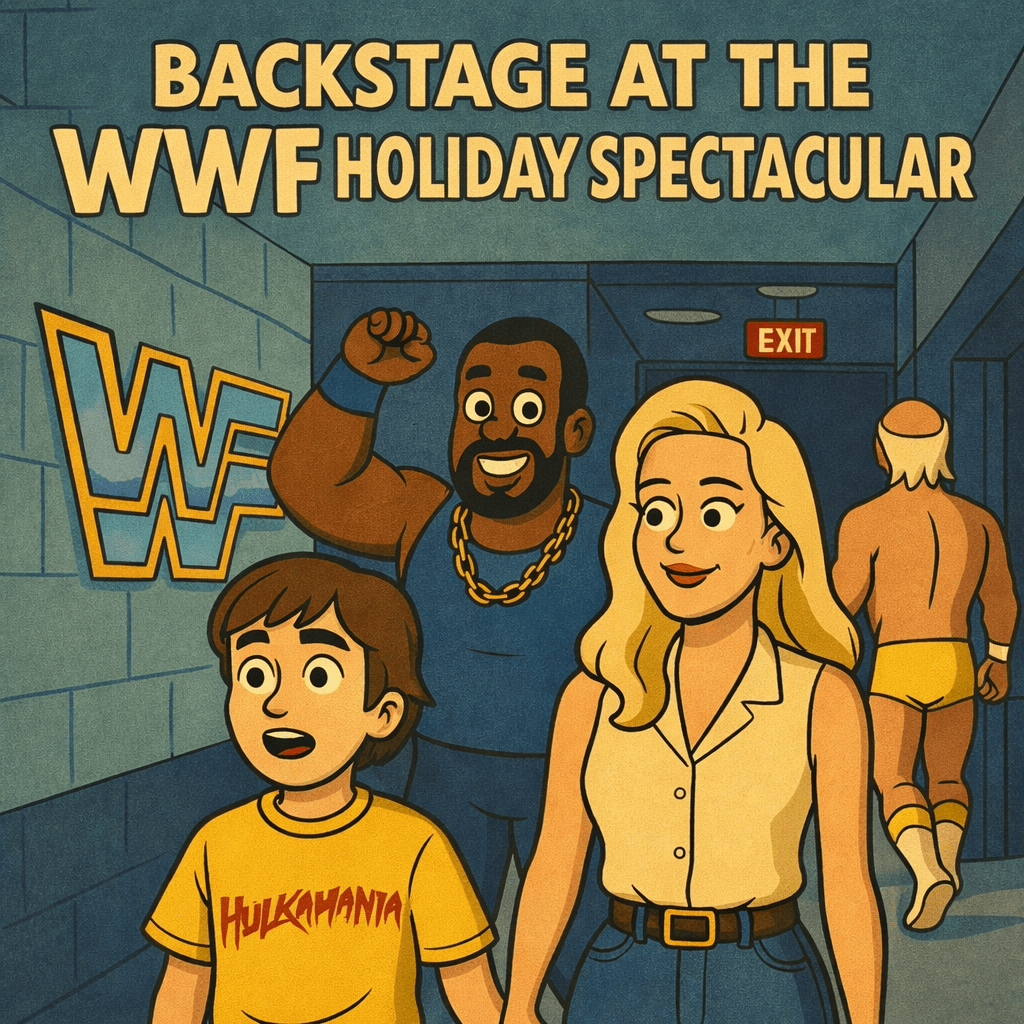
I walked in next to my mom, Jan, trying to play it cool.
But nothing about this was normal.
My mom had that look she sometimes got—the quiet, deliberate look—like she was arranging a moment on purpose. Like she knew I’d keep it forever. Because she was dating “Leaping” Lanny Poffo, she’d pulled off something that felt impossible.
We weren’t headed to our seats.
We were going backstage.
We moved toward this heavy curtain that separated “the show” from the world behind it. Right before we slipped through, my mom squeezed my shoulder.
“Take it in,” she said. “I want you to remember this.”
At the time, I thought she meant the wrestling—the matches, the entrances, the whole larger-than-life spectacle.
I didn’t understand she meant everything.
Because backstage was another universe.
Out there, heels and babyfaces were enemies—good guys and bad guys locked in some eternal war. Back here? They were just… people. Laughing. Roasting each other. Trading tape. Borrowing gear. Eating snacks like it was halftime at a Little League game. The entire illusion was still there, but it was loosened, unbuttoned, human.
And then I heard that voice.
Junkyard Dog spotted us first.
He had candy-cane sunglasses on—like he’d fully committed to “holiday show” in a way only JYD could.
“Well I’ll be!” he boomed, loud enough to rattle the lockers. “Young Eddie from Miami! Lanny’s been talkin’ about you.”
I froze. My brain did that thing where it goes blank but somehow also screams.
He leaned down, grinning like he’d known me forever.
“Relax, kid. I only bite the bad guys.”
Nearby, B. Brian Blair was admiring himself in the dented reflection of a metal locker, flexing like even backstage was still part of the show.
“You Lanny’s guy tonight?” he asked me.
Before I could even form a sentence, he tossed me a Killer Bees wristband.
“Honorary Bee.”
I looked down at it like it was a relic.
And behind me, my mom was smiling—not because of the celebrities, not because she was impressed by fame, but because she could see what was happening to me. She could see me standing a little taller than I had five minutes earlier.
Then Lanny appeared.
He came out in shimmering purple gear, hair wild, grin warm—like he’d stepped out of TV and into my real life without any warning.
“There you are,” he said. “My favorite Miami crew.”
He leaned in, conspiratorial.
“I’m dedicating my poem to you tonight,” he whispered. “And don’t worry—I’m not going to embarrass you.”
My mom raised an eyebrow like she had no idea what he was talking about, which was hilarious because she’d basically engineered the entire night.
When it was time, we went out and the building changed. The crowd had that roar that isn’t just sound—it’s pressure, like the air itself is vibrating. I ended up right at the barricade, my mom next to me, the heat from the lights washing over us.
Lanny stepped into the ring and lifted the microphone. The arena didn’t go silent exactly, but it quieted in that way where everyone senses something special is about to happen.
“This one,” he said, “is for a young man I’m proud to know—Eddie Stephens.”
And suddenly I couldn’t breathe right.
Because it’s one thing to love something from the stands. It’s another thing to have it call your name—publicly—like you’re part of the show.
I felt my mom beside me, and when I glanced at her, her eyes were shining.
This poem wasn’t about a first match. It was about a fan who knew the game — who understood heroes and villains, who could spot the work and still pop for the magic. He talked about Miami, about heart, about voice. About standing there and making your case when the moment mattered.
I felt my chest tighten. My mom blinked back tears.
Then Lanny reached into his bag.
The frisbee.
He spun and launched it high. I jumped — missed it by inches — and for a split second I thought the moment was gone.
A guy behind me bobbled it, cursed, slapped it forward.
It dropped straight into my arms.
I froze, clutching it like it might vanish.
My mom screamed louder than anyone around us.
“He caught it! He caught it!”
I turned to her and she was laughing and crying at the same time — completely alive, completely present. That image never left me.
After the show, backstage was louder and definitely not kid-appropriate. My mom half-covered my ears and smiled anyway.
Lanny put a hand on my shoulder.
“You’ve got good instincts,” he said. “Ever think about getting in the ring?”
I shook my head.
“I don’t think I want to fight like that,” I said. “But I like how they stand there. How they talk. How everyone listens.”
He smiled like he understood immediately.
“You want to make your case.”
I nodded.
“I want to argue. I want to win.”
From across the room, JYD laughed.
“That kid’s dangerous,” he said. “He’s already thinkin’.”
My mom watched quietly. She hadn’t just brought me backstage. She’d shown me what confidence looked like. What command felt like. How presence could fill a room.
The following year, my mother died.
Tragically. Suddenly. Far too soon.
And that night — December 1985 at the Miami Knight Center — changed forever. It became a core memory. A place I go back to when I need her voice, her laugh, her hand steady on my shoulder.
I replay it all the time: the crowd, the lights, the frisbee in my hands, and my mom just behind me — close enough to catch me if I fell, far enough to let me stand.
Years later, in courtrooms far from Miami, I still feel her there. Still hear her say, Take it in. Remember this.
The frisbee wasn’t just a souvenir.
It was proof that for one perfect night, my mother gave me the world — and trusted me to carry it forward.

 Core Memories
Leave a comment