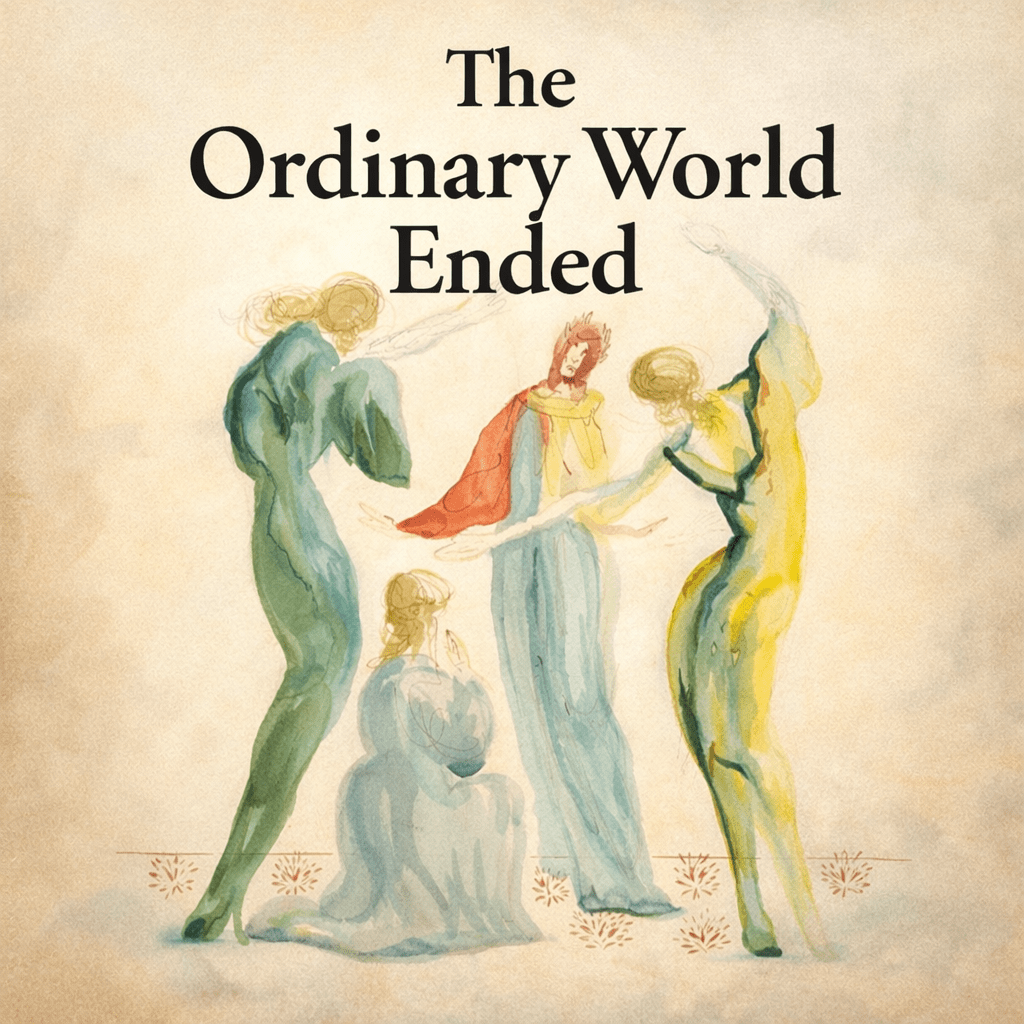


Trigger Warning
The following chapter includes depictions of a medical emergency, overdose, and the death of a parent, as well as themes of grief, trauma, and family conflict. Some readers may find this content psychologically distressing or triggering. Please take care of yourself—pause, skip ahead, or stop reading if you need to. If you are feeling overwhelmed, consider reaching out to someone you trust or a mental health professional for support.
———
I remember the hallway before I remember the room.
Her bedroom door was mostly closed.
I knocked anyway—twice—because that’s what you do when you’ve been raised to respect boundaries, even when your instincts are screaming that something is wrong. No answer. I pushed the door open and the first thing that hit me wasn’t a sight. It was the stillness. A stillness so complete it felt like it had weight.
She was on the bed. Not sleeping. Not resting.
Unresponsive.
I said “Mom?” like the word could pull her back. I said it again, louder, and the sound came out thin and useless, like a paper cup cracking in your hand. I moved closer and saw the bottle on the nightstand—Tylenol—emptied out like it had been poured into the air.
My brain tried to make it ordinary. Tried to put it in a box labeled misunderstanding or exaggeration or she’ll wake up and be furious you’re hovering.
But my hands were already shaking. My mouth was already dry. My heart was already sprinting ahead of the story, trying to outrun what my eyes were confirming.
I didn’t know what to do.
So I did what kids do when reality becomes unbearable: I called the oldest authority I knew.
My grandmother answered like she always did—steady, controlled, polished. I can still hear the click of her voice settling into place, as if she’d put on pearls before picking up the phone.
“Where are you?”
“In Mom’s room. She’s—she won’t wake up. There’s an empty bottle. I don’t know—”
A pause. Not the pause of panic. The pause of calculation.
And then: “Don’t call anyone.”
I blinked. “What?”
“Do not call for help,” she said again. “You don’t know what this is. You don’t want the neighbors involved. You don’t want an ambulance outside. People talk.”
People talk.
As if the greatest danger in that room was gossip.
She treated it like regular “drug behavior,” like something shameful and familiar—something you handle privately, quietly, behind a closed door.
And maybe in her mind, that was love: damage control. Keeping the family name intact.
But in my mind, there was only one story that mattered.
I looked at my mother—at the shape of her, at the fact of her—and something in me snapped in the best possible way.
Not a collapse.
A refusal.
A rebellion so pure it didn’t feel brave. It felt automatic, like a switch flipping inside my spine.
I said, “No.”
I didn’t even say it to my grandmother. I said it to the universe. To whatever part of our family history believed obedience was the same thing as loyalty.
My fingers dialed anyway.
When the paramedics arrived, the house filled with motion—purposeful, urgent motion that cut through the polite Coral Gables silence. I remember the stretcher, the commands, the equipment. I remember how professionals move when they’ve seen this before.
They worked and worked and worked, and I stood in the doorway feeling both too present and not present at all. Like my body was there, but my mind had stepped outside itself to survive what it was watching.
And still… it was too late in the way that counts.
My mom didn’t die that day. Not exactly.
She stayed in that in-between place for six days—six long, brutal, suspended days.
And then she died.
Afterward, everyone has a version of the story they can tolerate.
Some people made it a tragedy with a clean moral. Some people made it a cautionary tale. Some people made it a family secret, folded neatly and put away like a stained tablecloth.
But the version that lived inside me was the one nobody else could carry. The moment where a phone call could have decided what kind of person I would become.
Because here’s the truth that haunted me—and saved me:
If I had followed orders… I would have survived the day, but I don’t know if I would have survived myself.
Calling for help didn’t change the outcome. That ending came anyway.
But it changed me.
It meant that when I look back on that moment, when the world tilted, I don’t have to carry an extra burden of: “what if I hadn’t tried”.
I tried.
I chose love.
And who knew—standing in that doorway, with my hand on the phone and my whole body shaking—who knew that the first real adult decision of my life would be this:
To rebel against my family rulebook.
To choose compassion over reputation.
That day didn’t just break my heart.
It forged my spirit.
And everything after—every fight for someone who couldn’t fight for themselves, every time I chose to act when it would’ve been easier to look away—started right there, in that quiet Coral Gables room, when I decided that love was worth the noise.
Before my mother died, I wasn’t a student in the way people mean it when they say the word with pride.
I showed up. I existed inside classrooms. I did enough to move forward in the Miami-Dade school system, but I wasn’t engaged. I wasn’t hungry. I wasn’t building anything. Somewhere along the line, I got “deemed” special—the kind of label that doesn’t feel like a superpower. It feels like a sentence.
Once the adults decided I needed “extra attention,” I started living down to the expectation. I disengaged. I stopped actively learning. Not because I couldn’t—because I didn’t believe it mattered.
If you’re told often enough that you’re the kid who needs help, you start performing helplessness like it’s your job. You stop reaching for the top shelf because you’re convinced it was never meant for you anyway.
The irony is: I was brilliant in ways no one wanted to measure.
I proved it the way kids sometimes prove things—chaotically.
I didn’t break rules; I broke systems.
I brought the Miami-Dade School District computer system to its knees. Not with violence, not with cruelty—just with curiosity and an instinct to see what happens if you push the right button at the wrong time. I found the seam in the world and pulled.
That earned me a new kind of label. A new assignment.
My sister got sent to the school for smart kids—the place that said, We see you. We’re going to feed you.
I got sent to the place for kids who needed “extra attention,” which is the polite way of saying, We don’t know what you are, so we’re going to manage you.
It’s wild how early life teaches you roles.
My sister: gifted.
Me: problem.
And if you’re a kid who already feels untethered, you’ll wear that role like armor. You’ll act it out just to prove everyone right.
Then came the bedroom in Coral Gables.
Then came the phone in my hand.
Then came the moment when the ordinary world ended and nothing—nothing—could ever be casual again.
After my mother died, school changed shape.
It stopped being a place I attended and became a life raft.
Grief is not just sadness. It’s drowning. It’s being pulled under by something invisible while everyone else is still breathing like normal. And when you’re drowning, you reach for anything that holds you above the surface.
For me, that thing was achievement.
Not because I suddenly loved worksheets.
Because perfection is control.
Because an A is a clean outcome in a world that has become unclean.
Because a perfect score is a receipt that says, I did something right, on a day when everything you loved feels wrong.
From that day forward, I didn’t get less than perfect scores. Straight A’s. Through high school, through college, through law school—like flipping a switch and never turning it off again.
People love the story of the turnaround. They want it to be inspiring. They want the montage: tragedy, then triumph, then applause.
But the truth is more complicated than that.
It wasn’t just motivation.
It was survival.
It was the way my mind built a system after the old system collapsed.
It was a boy who couldn’t save his mother deciding that he would never again be powerless in a moment that mattered.
And yes… it makes you wonder.
Can one event do that? Can one series of moments turn a disengaged kid into an overachiever?
I think it can. But maybe it’s not the event itself. Maybe it’s the bargain you make afterward.
Because somewhere in the wreckage, a vow gets spoken—sometimes out loud, sometimes only in the bones:
I will not be the kid who fails again.
I will not be the one who didn’t do enough.
If I can’t control life, I will control my performance.
That vow can build a career. It can build a reputation.
It can build a straight-A transcript that looks like proof of something healed.
But it can also become a haunting.
Because perfection is a powerful drug.
And grief… grief doesn’t disappear just because you’ve learned to win.
It just waits in the background, taking notes.
I didn’t realize was how much trauma I was carrying, how much of that excellence was built on emergency fuel. The grief didn’t disappear; it just went quiet.
And the cracks continued…
…unaddressed.

 Core Memories
Leave a comment