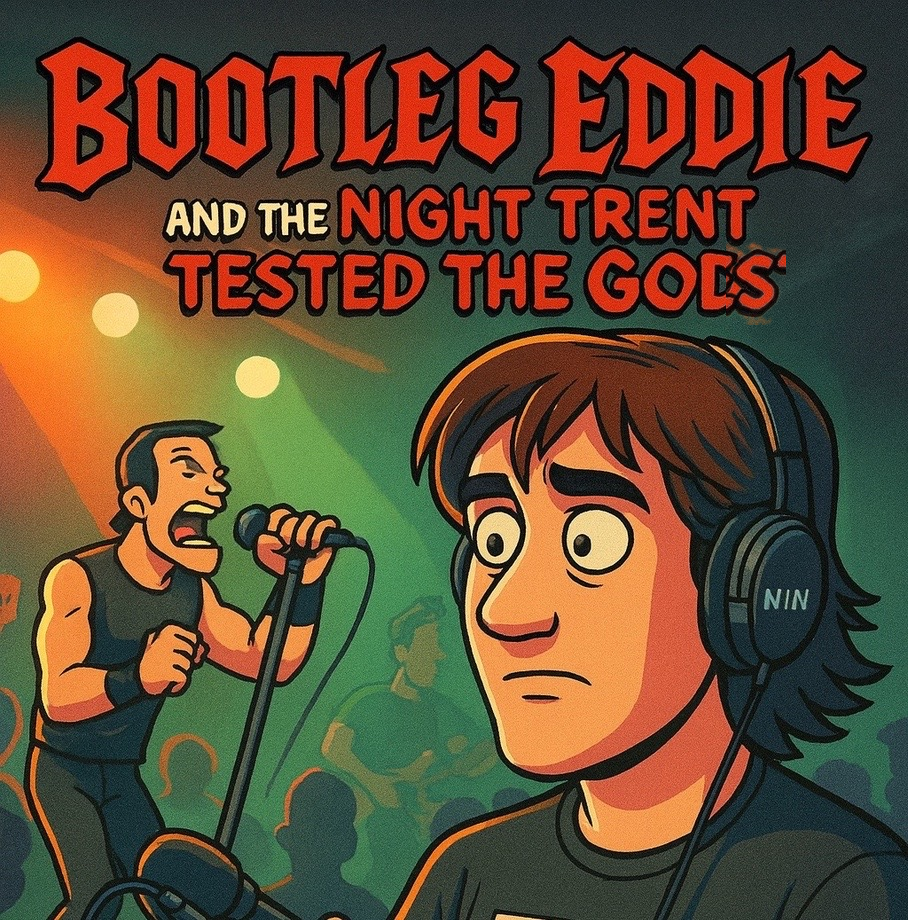


There was a time before Stephens & Stevens.
Before Squibs.
There was a time when I was just Bootleg Eddie.
Back then, I flew under the radar. I traveled light. A backpack with questionable electronics. And a very specific mission: capture moments no one else could — or was supposed to.
I wasn’t chasing fame. I was chasing proof.
And on one cold Chicago night, fate handed me the ultimate assignment.
The word moved fast through the underground — faster than feedback from a broken stompbox:
Trent Reznor was playing a secret club show.
No announcement.
No press.
No safety net.
Newly sober. Newly resurrected. Dangerous again.
This wasn’t a tour stop.
This was a test.
Did he still have it?
I didn’t hesitate.
I booked a flight using miles I absolutely should not have used, packed my tiny silver digital camera, and boarded a plane with the confidence of someone who’d done this exact kind of thing too many times to pretend it was accidental.
The venue was small.
Too small.
A thousand people crammed inside like a pressurized confession booth. Sweat. Anticipation. The faithful packed shoulder-to-shoulder, all of us knowing we were about to witness something fragile and volatile.
Then the lights dipped.
A silhouette stepped forward.
Trent.
Clean. Focused. Sharp as wire.
No speech.
No preamble.
Just—
“Somewhat Damaged.”
The first drum hit rattled the walls.
I raised my camera, tucked tight against my jacket like a concealed weapon, and hit record.
For about twenty seconds, the room was pure electricity.
And then—
POP.
CRACK.
HISS.
Silence.
Trent froze.
You could almost see the storm cloud form above his head. And then — because of course — he destroyed a mic stand, kicked a monitor, and stormed offstage like an angry god betrayed by mortals.
The crowd gasped.
The staff groaned.
Security immediately went into hunt mode.
I felt him before I saw him.
A security guard built like a refrigerator, neck tattoo, zero patience, standing directly over me.
“Sir,” he said. “Is that a camera?”
Now, Bootleg Eddie was many things — reckless, obsessive, armed with too many spare AA batteries — but above all, I was prepared.
I flipped the camera open in one smooth motion, popped the battery out, and placed it in his hand like I was performing a magic trick.
“There,” I said. “Useless.”
He looked at the battery.
He nodded.
Ritual sacrifice accepted.
He walked away.
I waited. Counted breaths. Watched him disappear into the dark.
Then — slowly, ceremonially — I reached into the inside pocket of my jacket.
Fresh batteries.
Of course I had extras.
I slid them in, snapped the camera shut, and hit record again.
Just as Trent walked back onstage.
If the first attempt was divine chaos, the second was resurrection.
Trent tore into the set like a man clawing his way back to life:
The Fragile The Becoming Wish — which nearly tore the roof off the place And a stripped-down, haunting “Hurt” that left the entire room in stunned silence
And I captured all of it.
Perfectly framed between the shoulders of two frantic fans.
The glow of the tiny screen reflecting back at me like a private pact with history.
By the time the last note rang out, I knew exactly what I had.
The kind of footage urban legends are built on.
And security?
Still walking the floor with one lonely battery in a pocket.
Years later, people still whisper about it.
A mysterious, impossibly steady, multi-angle-quality bootleg of Trent Reznor’s “still got it” comeback show.
Shot on a grainy little digital camera.
Never traced.
Never explained.
They say the cameraman never got caught.
They say the battery trick was planned from the start.
They say I still keep that Chicago ticket stub in a drawer next to my best memories.
They’re right.
Because some versions of you never disappear.
They just go underground.
Bootleg Eddie lives.

 Core Memories
Leave a comment